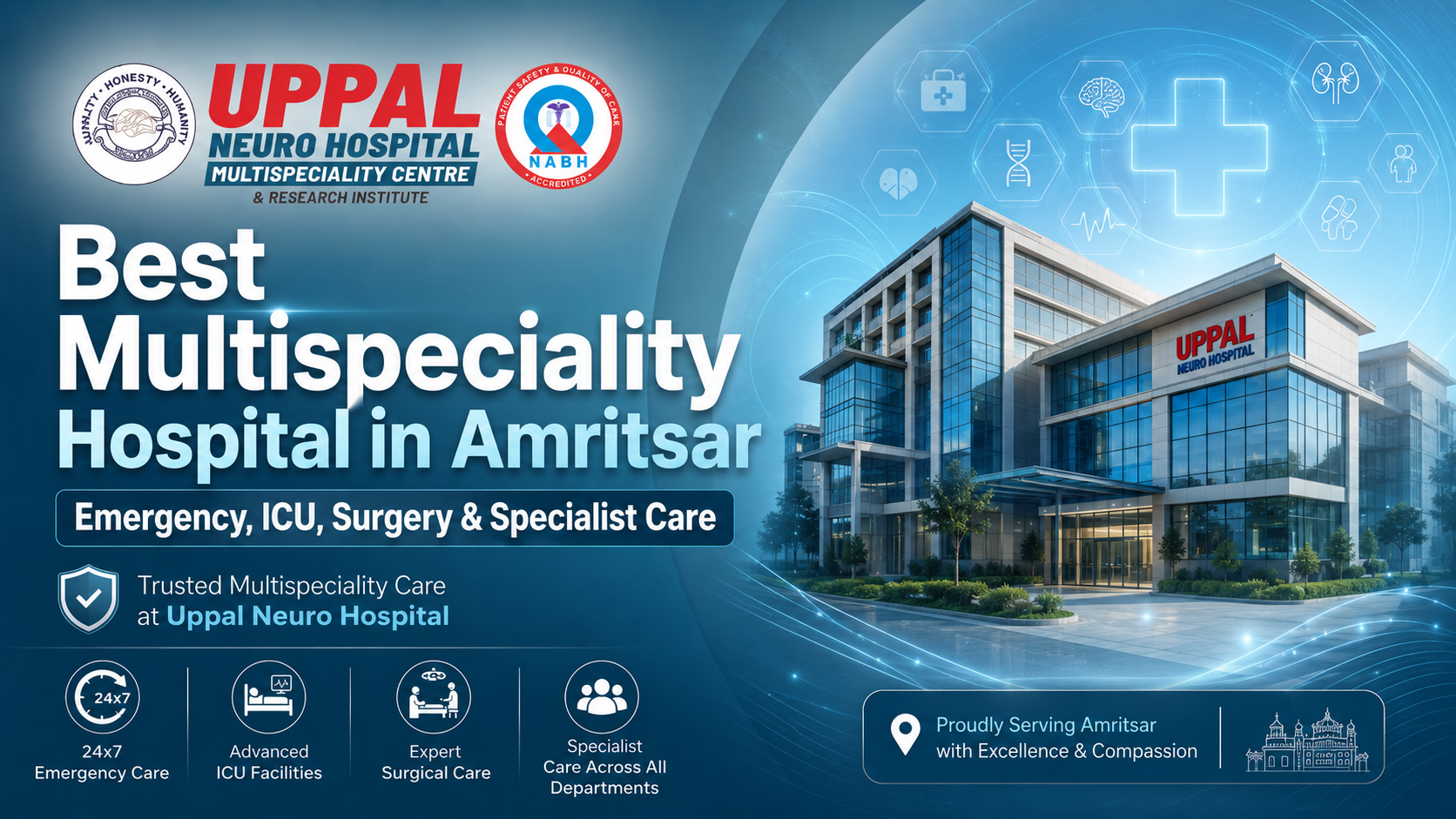
Best Multispeciality Hospital in Amritsar for Emergency, ICU, Surgery, and Specialist Care
Amritsar is an important decision, particularly when a patient requires emergency treatment, intensive care, surgery, or coordination between several medical specialists.
In such situations, families need more than a well-known hospital name.
They need timely assessment, suitable diagnostic facilities, experienced doctors, critical-care support, clear communication, and continuity of care.
Emergency, critical, and operative services are closely connected. A patient arriving with a stroke, serious injury, breathing difficulty, infection, or sudden complication may need emergency stabilisation, imaging, specialist evaluation, surgery, ICU monitoring, and rehabilitation within the same treatment journey.
The World Health Organization recognizes this coordination as an important part of effective acute healthcare.
This article explains the qualities that patients and families should have in mind when comparing hospitals in Amritsar.
What Defines the Best Multispeciality Hospital in Amritsar?
A multispeciality hospital brings different medical and surgical departments together within one healthcare facility.
This allows patients with complex conditions to be evaluated by doctors from more than one speciality when necessary.
For example, a person admitted after a road accident may require emergency physicians, radiologists, surgeons, anaesthesiologists, orthopaedic specialists, neurologists, and critical-care doctors.
Similarly, an older patient with diabetes, kidney disease, and a neurological problem may need a coordinated treatment plan rather than isolated consultations.
The best hospital for an individual patient should therefore be evaluated on practical factors such as:
- Availability of emergency and critical-care services
- Access to relevant medical and surgical specialists
- Diagnostic imaging and laboratory support
- Operation theatre and anaesthesia capabilities
- ICU monitoring and trained critical-care professionals
- Infection-control and patient-safety practices
- Rehabilitation and post-discharge support
- Communication with patients and attendants
- Ambulance, pharmacy, ward, and insurance facilities
A hospital should not be selected only because it appears first in an online search. Its facilities must match the patient’s condition and expected level of care.
Why Emergency Care Is a Critical Selection Factor
A dependable emergency hospital in Amritsar should be prepared to assess urgent symptoms, establish priorities, stabilise the patient, and involve the appropriate specialist without unnecessary delay.
Conditions that may require immediate hospital evaluation include:
- Sudden weakness or numbness on one side of the body
- Difficulty speaking or understanding speech
- Severe chest pain or breathing difficulty
- Loss of consciousness
- Serious head or spinal injury
- Uncontrolled bleeding
- Repeated seizures
- Severe abdominal pain
- Sudden confusion
- Major burns or trauma
- Signs of severe infection or shock
During an emergency, the initial medical team may need to check the patient’s airway, breathing, circulation, consciousness, vital signs, and injury severity.
Blood tests, X-rays, CT scans, or other investigations may be needed depending on the symptoms.
The strength of an emergency department is not based only on how quickly a patient enters the building.
It also depends on how efficiently the hospital can move the patient from assessment to diagnosis, specialist consultation, surgery, ICU admission, or another appropriate level of care.
What to Look for in an ICU Hospital in Amritsar
An intensive care unit is designed for people who are critically ill, medically unstable, recovering from major surgery, or in need of continuous monitoring and organ support.
Patients in an ICU may require equipment that monitors heart rate, blood pressure, oxygen levels, and other important functions.
Depending on the condition, treatment may also involve ventilator support, intravenous medicines, feeding support, drains, or other specialised interventions.
When evaluating an ICU hospital in Amritsar, families can ask about:
- Critical-Care Specialists: ICU care should involve doctors and nurses trained to recognise and manage rapid changes in a patient’s condition. Anaesthesiologists, intensivists, physicians, neurologists, surgeons, and other specialists may participate depending on the diagnosis.
- Monitoring and Life-Support Facilities: The ICU should have appropriate systems for continuous observation, medication administration, respiratory support, and emergency intervention.
- Access to Diagnostics: Critically ill patients may need frequent blood tests, imaging, or bedside investigations. Access to diagnostic services can support quicker clinical decisions.
- Multidisciplinary Coordination: A patient in intensive care may have problems affecting more than one organ system. Collaboration between critical-care doctors and specialists in neurology, cardiology, nephrology, internal medicine, surgery, or other departments can be essential.
- Family Communication: ICU care can be emotionally overwhelming. Families should receive clear explanations about the patient’s condition, treatment priorities, expected investigations, and important changes in the care plan.

Evaluating Surgical Care and Operation Theatre Support
Surgery involves more than the procedure itself. Safe surgical care begins with accurate diagnosis and preoperative assessment and continues through anaesthesia, monitoring, recovery, pain management, wound care, and follow-up.
When comparing hospitals for surgery, patients should consider the complete surgical pathway.
- Preoperative Assessment: Before surgery, the medical team may evaluate the patient’s overall health, current medicines, allergies, previous procedures, heart and lung function, and risk factors. Blood tests, imaging, or specialist clearance may be required.
- Qualified Surgical and Anaesthesia Teams: The hospital should have professionals with experience in the relevant procedure. Anaesthesia and critical-care support are particularly important for major operations and patients with additional health conditions.
- Postoperative Monitoring: After surgery, patients may recover in a post-anaesthesia area, hospital ward, high-dependency unit, or ICU. The appropriate setting depends on the complexity of the surgery and the patient’s stability.
- Patient-Safety Systems: Medication errors, diagnostic errors, unsafe procedures, infections, communication gaps, and patient-identification problems are recognised sources of preventable harm.
Hospitals should use organised systems, defined procedures, trained teams, and patient engagement to reduce these risks.
No hospital can promise a risk-free procedure or guaranteed outcome.
However, patients can ask how surgical risks are explained, how consent is obtained, and how complications are monitored and managed.
Access to Multiple Medical Specialists
One of the main advantages of choosing a multispeciality hospital in Amritsar is access to different specialists within a coordinated environment.
Depending on the hospital, departments may include:
- Neurology and neurosurgery
- General medicine
- General surgery
- Cardiology
- Orthopaedics and joint replacement
- Nephrology
- Urology
- Gastroenterology
- ENT
- Medical oncology
- Radiology
- Pathology
- Psychiatry
- Rehabilitation and pain management
Not every patient needs all these services.
The benefit is that another specialist may be consulted when the primary condition affects a different organ system or when an unexpected complication appears.
Before making an appointment, patients should confirm that the hospital currently has the required specialist, diagnostic facility, and treatment capability.

The Role of Diagnostics in Faster Clinical Decisions
Treatment decisions depend on accurate information. A well-equipped hospital should be able to support doctors with appropriate imaging, laboratory investigations, and specialised diagnostic tests.
Depending on the patient’s symptoms, these may include:
- Blood and urine investigations
- X-rays
- Ultrasound
- CT imaging
- MRI
- Cardiac tests
- Neurophysiology tests
- Pathology and microbiology services
For neurological emergencies such as stroke, seizures, head trauma, or sudden loss of consciousness, access to suitable imaging and specialist assessment can be particularly important.
Patients should remember that advanced technology alone does not determine care quality. The results must also be interpreted correctly and connected to a practical treatment plan.
How to Compare the Best Hospital in Amritsar for Your Needs
The phrase “best hospital” can mean different things to different patients. A facility suitable for a planned orthopaedic procedure may not be the right choice for an acute neurological emergency.
The most appropriate hospital is the one that can safely manage the specific condition.
Before choosing a hospital, consider asking these questions:
- Does the hospital treat the patient’s particular condition?
- Is the required specialist available?
- Are emergency services accessible when needed?
- Is ICU support available for medically complex cases?
- Can the necessary investigations be performed within the facility?
- Does the hospital offer the required surgical procedure?
- How are patients and families informed about treatment decisions?
- Are insurance or third-party administrator services available?
- What rehabilitation or follow-up support is offered?
- What should the family do if the patient’s condition is worsed?
For planned treatment, patients may also seek a second medical opinion before making a final decision.
Uppal Neuro Hospital – Multispeciality and Neurocare Services in Amritsar
Uppal Neuro Hospital is located in Rani Ka Bagh, Amritsar, and was established in December 2000 with an initial focus on advanced care for neurological conditions.
Its official website currently lists services and departments covering stroke management, epilepsy treatment, brain and spine surgery, trauma care, neuro critical care, paediatric neurology, neurorehabilitation, cardiology, orthopaedics, internal medicine, general surgery, urology, nephrology, gastroenterology, ENT, and other specialities.
The hospital’s website also lists neuroimaging, neurophysiology diagnostics, clinical laboratory services, an ambulance facility, pharmacy, rooms and wards, dietary services, day care, teleconsultation, and insurance or TPA support. It describes the facility as having more than 120 beds.
Patients should contact the hospital directly to confirm current doctor availability, admission procedures, emergency arrangements, and whether a particular treatment is offered before travelling.
Conclusion
Finding the Best Multispeciality Hospital in Amritsar requires more than comparing advertisements or online rankings.
Patients should examine emergency readiness, ICU support, specialist availability, diagnostic capabilities, surgical systems, patient safety, communication, and rehabilitation services.
For residents of Amritsar and patients travelling from other parts of Punjab, choosing a hospital that can coordinate different stages of care may make the treatment experience more organized.
The final decision should always be based on the patient’s condition, the required speciality, and direct guidance from qualified medical professionals.
Medical note: This article is intended for general education and does not replace diagnosis, emergency evaluation, or personalised advice from a qualified doctor. In a medical emergency, seek immediate care from the nearest appropriate emergency facility.
Frequently Asked Questions (FAQ’s)
1. What services should the best multispeciality hospital in Amritsar provide?
A suitable multispeciality hospital should offer access to emergency assessment, relevant specialists, diagnostic services, surgical facilities, ICU support, pharmacy services, inpatient care, and follow-up or rehabilitation. The exact requirements depend on the patient’s medical condition.
2. When should a patient be taken to an emergency hospital in Amritsar?
Immediate medical evaluation may be needed for severe chest pain, breathing difficulty, stroke symptoms, serious injury, uncontrolled bleeding, loss of consciousness, repeated seizures, severe abdominal pain, or sudden confusion. Do not delay emergency care while trying to arrange a routine appointment.
3. What is the difference between an ICU and a regular hospital ward?
An ICU provides closer observation and a higher level of medical support for critically ill or unstable patients. ICU patients may require continuous monitoring, ventilator support, intravenous medicines, or specialised nursing and medical care.